
Posts by Conrad Hughes
The Role of Game Design in Shaping Modern Higher Education

At University of the People, we recently launched a certificate program in Game Design. This fully online program provides learners with hands-on experience in game mechanics, storytelling, prototyping, and game development. Students also complete a playable game as a final project, building practical skills and a portfolio piece for future opportunities. Games tie directly into what makes us human, operating according to the mysterious and intrinsic sense…
Read MoreWorld Refugee Day: The Power of Education in Rebuilding Lives

Today is World Refugee Day, a time to recognize the resilience, determination, and aspirations of millions of people who have been forced to flee their homes in search of safety and opportunity. Displacement is one of the defining humanitarian challenges of our time. According to UNHCR’s latest Global Trends Report, more than 123 million people worldwide…
Read MoreThree Women Who Changed the Way the World Learns

When we look at leaders in educational practice and theory, three women stand out as being particularly transformative in their vision. Across different eras and contexts, their work demonstrates how access to education can reshape both individual lives and entire societies. Maria Montessori (1870–1952) Montessori revolutionized pedagogy with the construct of child-centered or inquiry-based learning.…
Read MoreData-Informed Decision-Making in Education: Building Smarter, More Equitable Institutions

We all know that data-informed decision-making is better than intuition and face value judgment. Data, whether cold or warm, does not always underscore our impressions and can be counterintuitive, telling a different story to the one we would like to believe. Fundamentally, decisions taken using data well and intentionally will tend to address genuine institutional…
Read MoreBeyond the Degree: The Power of Stackable Credentials in Pursuing Deep Knowledge

The modern world of work is evolving at lightning speed—driven by technological change, global connectivity, and an ever-growing demand for applied, demonstrable skills. In this fast-paced environment, traditional education models are being reimagined, and stackable credentials—from micro-credentials and certificates to digital badges—are emerging as powerful tools to help learners keep pace. As highlighted in a review published in the International Journal of…
Read MorePreparing Students for the Future: Thriving in AI-Disrupted Jobs

AI is reshaping industries at an extraordinary pace. A 2025 Stanford study found that over the past three years, AI automation has reduced opportunities for entry-level software developers and young people seeking jobs in customer service. Similarly, research from the Federal Reserve Bank of St. Louis indicates that occupations with high AI exposure—particularly in computer,…
Read MoreLifelong Learning: The Cornerstone of Thriving in a Rapidly Changing World

Of all the knowledge, skills, and dispositions required to succeed in the 21st century—and almost certainly in the decades ahead—lifelong learning stands out as one of the most vital. In a world shaped by relentless technological change, shifting career landscapes, and global uncertainty, the ability to continuously learn and adapt is no longer a luxury.…
Read MoreThe Role of Digital Citizenship in Shaping Informed and Ethical Students

20th-century philosopher Hannah Arendt theorized that genuine global citizenship is unattainable, as the concept of citizenship is intrinsically linked to nation-states. Quoting her, “a citizen is by definition a citizen among citizens of a country among countries. His rights and duties must be defined and limited, not only by those of his fellow citizens, but also…
Read MoreThe Importance of Accreditation in Education

University accreditation started with the expansion of education in the 19th Century and the need to regulate, standardize, and vouch for the credibility of any given institution’s offering. Accreditation allowed for some sense of expectations and standards and, in doing so, harmonized educational practices across different schools, colleges, and universities. Today, accreditation is a staple…
Read MoreAdvocating for a Human-Centered Approach to AI Integration in Education
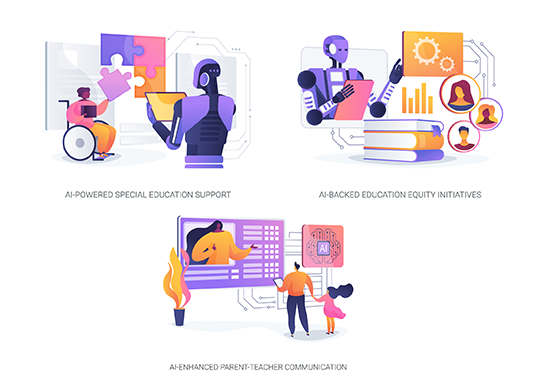
Recently we celebrated World Education Day and much of the reflection that took place across think tanks, research hubs, and educational institutions was focused on Generative Artificial Intelligence and what its implications are for educational practice. With the rapid advancement and integration of AI tools in various sectors, including education, it becomes crucial to prioritize…
Read MoreProject-Based Learning: Thriving in the Digital Age

Project-Based Learning (PBL), although not without its detractors and critics, has long been championed by theorists like Dewey and Vygotsky for its emphasis on active learning, constructivism, and social interaction. This powerful pedagogy can flourish in an online environment. Online PBL leverages technology to facilitate collaboration, research, and knowledge creation. Students can connect with peers…
Read MoreTransferring College Credits is Advantageous

Universities are more than places of academic learning: they are real communities where relationships are developed and bonds are formed. As such, the community of learners that makes up a university is an important expression of what college life is like. Some students spend several years together and become close friends as part of the journey. The student experience depends…
Read More