
World Refugee Day: The Power of Education in Rebuilding Lives

Updated: June 12, 2026
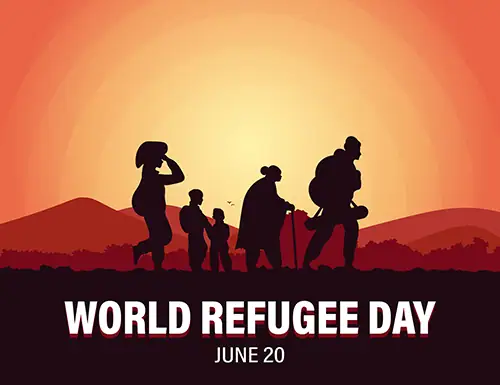
Today is World Refugee Day, a time to recognize the resilience, determination, and aspirations of millions of people who have been forced to flee their homes in search of safety and opportunity.
Displacement is one of the defining humanitarian challenges of our time. According to UNHCR’s latest Global Trends Report, more than 123 million people worldwide were forcibly displaced by the end of 2024 due to conflict, persecution, violence, and human rights violations. This figure has nearly doubled over the past decade, underscoring the growing scale of displacement around the world.
For those forced to leave their homes, the immediate priorities are often safety, shelter, food, and healthcare. Yet one critical need is frequently disrupted for months—or even years: education.
Education provides far more than academic knowledge. It offers stability during uncertainty, structure during disruption, and hope during difficult circumstances. For refugee children, youth, and adults, access to learning can be a lifeline that helps preserve opportunity and dignity while laying the foundation for a better future.
Unfortunately, educational access remains one of the greatest challenges facing displaced populations. Refugee learners often encounter barriers such as interrupted schooling, language differences, financial hardship, limited educational infrastructure, and the psychological impact of displacement and trauma. While some refugees are welcomed into national school systems or supported through scholarships and sponsorship programs, many others have limited access to formal education.
According to recent UNHCR data, 46% of refugee children remain out of school. Educational participation also declines significantly as students progress through the education system, making access to secondary and tertiary education particularly challenging for displaced learners.
The consequences can be profound. Education can help displaced learners develop the knowledge, skills, and credentials needed to rebuild their lives and pursue long-term opportunities. When educational opportunities are interrupted, individuals can find themselves trapped in cycles of instability and limited opportunity. Conversely, when learners can continue their education, they gain skills, confidence, and pathways to economic participation that can benefit entire families and communities.
The challenge becomes even greater at higher levels of education. While progress has been made over the past decade, access to higher education remains limited for refugee populations. Today, approximately 7% of refugees have access to higher education worldwide—a significant increase from just 1% a decade ago, but still far below global participation rates. To address this gap, UNHCR and its partners launched the 15by30 initiative, which aims to ensure that 15% of refugee youth have access to higher education by 2030.
This belief in the transformative power of education is at the heart of University of the People’s mission.
University of the People was founded on a simple but ambitious idea: that higher education should be accessible to qualified students regardless of their geographic location, financial circumstances, or life circumstances. At a time when many institutions around the world are becoming increasingly selective and inaccessible, it is more important than ever that universities committed to widening access continue to grow and serve learners who might otherwise be left behind.
Today, UoPeople serves more than 17,000 refugees and 17,500 internally displaced persons (IDPs) from over 200 countries and territories. These refugee learners are pursuing their educational goals despite extraordinary challenges. Building on this commitment, the university has pledged to educate 35,000 refugees and displaced persons by 2030. And through a collaboration with UNHCR and IBM, UoPeople is providing 5,000 IBM SkillsBuild professional certificates to refugee and internally displaced students, equipping them with in-demand skills and preparing them for careers in fields such as cybersecurity and data analytics.
For refugees, access to higher education often represents much more than a credential. It can restore a sense of continuity after disruption, provide structure during periods of uncertainty, and create pathways to economic self-reliance. Many refugee students describe education not only as an investment in their future careers but also as a source of confidence, purpose, and personal renewal.
The flexibility of online learning can be particularly meaningful for displaced learners whose circumstances may change unexpectedly. By reducing geographic barriers and allowing students to continue their studies from almost anywhere with internet access, online education can help ensure that learning does not come to a halt when life becomes unpredictable.
On World Refugee Day, we celebrate the extraordinary resilience of refugees who continue pursuing education despite immense obstacles. Their commitment to learning is a powerful reminder that talent, ambition, and potential exist everywhere, even where opportunity does not.
As educators, institutions, policymakers, and communities, we all have a role to play in expanding educational access for displaced learners. By creating pathways to education, we not only transform individual lives but also strengthen communities, promote self-reliance, and contribute to a more equitable and compassionate world.
Education cannot end conflict or displacement. But it can help ensure that those affected by them can rebuild, grow, and thrive.