UoPeople Helped Me Turn My Passion for Health Into a Research Career

Updated: October 21, 2026
I have always been interested in health—not only at the individual level, but also in how communities can achieve better health outcomes. I wanted to understand how scientific evidence could help identify health problems, evaluate possible solutions, and improve healthcare decisions.
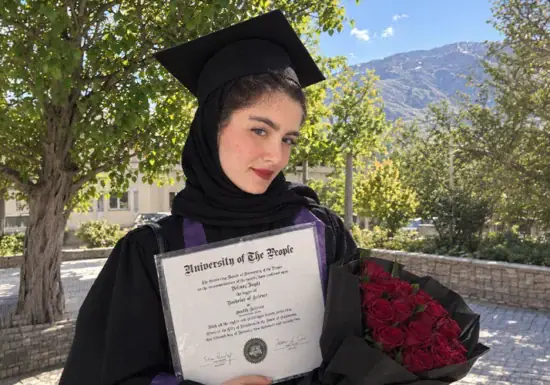
That curiosity eventually led me to University of the People, where I completed my bachelor’s degree in Health Science in 2025 with a GPA of 3.96.
Living in Iran, I faced financial and practical barriers to pursuing an international university education. UoPeople allowed me to earn a U.S.-based degree without leaving my country. More importantly, it helped me turn my interest in health and research into a clear academic direction.
Today, I am working toward a career in health research, particularly in occupational health and nurse burnout. My journey has shown me how education can turn an interest into the skills needed to investigate problems, generate evidence, and contribute to meaningful change.
Finding an International Education Opportunity Without Leaving Iran
I first learned about UoPeople through a Telegram group that shared opportunities to study at universities abroad. An Iranian woman living in the United States introduced the university to the group, and the idea of studying at an American university online immediately caught my attention.
I began researching UoPeople through its website, Google, and Instagram. At the time, I was not very familiar with Health Science as a distinct academic field because it is not commonly offered under the same title in Iran.
I spent considerable time reviewing the university catalog, course descriptions, and curriculum. The program aligned with my interests in individual and community health, statistics, biostatistics, scientific literature, academic writing, and research. I saw an opportunity to develop the skills needed to understand health problems through scientific evidence rather than assumptions.
Accessibility was another important consideration. Financial and logistical barriers, combined with the exchange rate and economic conditions in Iran, made studying at many U.S. universities seem largely out of reach.
UoPeople’s affordable model and scholarship opportunities changed that. Financial assistance, including opportunities that could be renewed based on academic performance and financial need, made it possible for me to pursue a U.S.-based university education while remaining in Iran.
I began my studies in 2021, determined to make the most of the opportunity.
Staying Committed to My Education Through Uncertainty
Because I relied on financial assistance to continue my studies, maintaining strong academic performance was especially important to me. However, in 2022, protests and widespread internet disruptions in Iran left me unable to reliably access the UoPeople learning platform for a period. Despite the uncertainty, I communicated with my instructors, who understood my circumstances and supported me in completing the term.
The experience reinforced the importance of perseverance and highlighted how circumstances beyond a student’s control can affect access to education. Later, learning about scholarship opportunities through UoPeople’s leadership to support Iranian girls and women deepened my appreciation for efforts to make higher education more accessible.
I ultimately graduated in 2025.
How My Health Science Degree Built My Research Skills
One of the most valuable aspects of my education was learning to connect health sciences with research and quantitative analysis.
Before enrolling, I was interested in health and scientific research, but I needed the methodological foundation to turn that interest into practical work. My coursework helped me develop skills in statistics and biostatistics, scientific reading, academic writing, referencing, and the critical evaluation of research findings. I became better equipped to examine available evidence, understand how conclusions were reached, and identify questions that might require further research.
My academic English also improved substantially. Studying Health Science in English helped me become more comfortable with specialized terminology, scientific literature, academic writing, and communicating research ideas. These skills have been particularly important as I have begun preparing manuscripts and engaging with international scientific publications.
I also benefited from UoPeople’s international learning environment. Interacting with instructors and classmates from different countries and academic backgrounds exposed me to new perspectives and strengthened my confidence.
Together, these experiences gave me a foundation that extended well beyond the classroom.
From My Capstone Project to My First Scientific Publication
Toward the end of my degree, I completed my Capstone project on nurse burnout under the guidance of Dr. Veronica Semenova.
The project was especially meaningful because nurse burnout was already an area of research interest for me. It allowed me to apply the skills I had developed throughout my studies to a specific healthcare problem. I wanted to understand nurse burnout more deeply and explore how research could contribute to better outcomes for healthcare workers and patients.
One of the first outcomes of this work was my scientific article, “A Narrative Review on Nurse Burnout: Prevalence, Determinants, and Protective Mechanisms.” The article has been accepted by the Journal of Multidisciplinary Care and is currently in press.
Preparing the manuscript independently was a significant milestone. It allowed me to apply what I had learned at UoPeople, from reviewing scientific literature and structuring an academic paper to preparing a manuscript for submission.
I am also contributing to another review article that is currently under peer review. These experiences have strengthened my confidence in pursuing research and shown me how academic skills developed during a degree can translate into tangible progress after graduation.
Looking Ahead: Research That Improves Health Outcomes
I will soon begin a master’s degree in Occupational Health in Iran, while working toward my goal of conducting an original quantitative study on occupational burnout among Iranian nurses. I hope to strengthen my research skills, publish high-quality studies, and contribute evidence that can inform health policies and improve healthcare professionals’ well-being.
I also enjoy sharing knowledge and voluntarily help others understand research methods and statistical concepts, including regression. My UoPeople degree gave me the foundation to critically evaluate scientific evidence, analyze data, and develop research questions. I hope to build on these skills to make research more accessible and contribute to better health outcomes.
My Advice to Current and Prospective UoPeople Learners
My advice to current and prospective UoPeople students is to take the academic skills they develop seriously, even when a course requirement may not seem immediately relevant to their plans.
Statistics, academic writing, research methods, scientific reading, and proper referencing may initially feel like separate requirements. In practice, they work together to create a foundation that can be applied far beyond the classroom.
My experience taught me that difficult circumstances can create real obstacles, but perseverance and support can make a difference. I am grateful to UoPeople’s leadership, faculty, program advisors, and staff, particularly the instructors who supported me during challenging periods. Completing my degree while living in Iran strengthened my confidence in pursuing research opportunities at an international level.
About the Author
Behnaz F. is a UoPeople graduate from Iran who completed her bachelor’s degree in Health Science in 2025. Her research interests include occupational health and nurse burnout. Her first scientific article, “A Narrative Review on Nurse Burnout: Prevalence, Determinants, and Protective Mechanisms,” has been accepted for publication and is currently in press. She plans to pursue a master’s degree in Occupational Health while continuing to develop her research skills and contribute to evidence-based approaches to improving health outcomes.