
The Future of Teaching in the Age of AI: Why Human-AI Collaboration Matters

Published: August 13, 2026
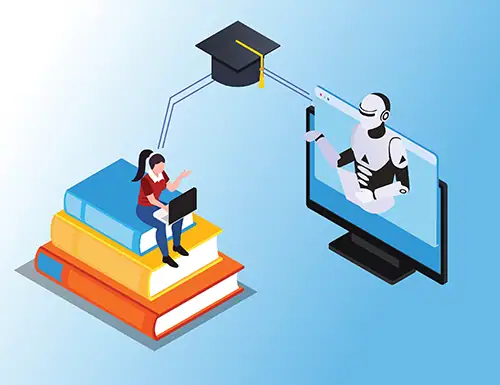
AI is not just another evolution in technology; it is a development that touches the nerve center of education. It allows humans to generate thoughts, points of view, analytical frameworks, and creative insights without necessarily doing all the cognitive work traditionally required to arrive at them. This begs the deep and enduring question: what are schools for? We are clearly not interested in a performative, artificial environment where the product is all that counts; instead, we want to nurture thought, explore ideas, and give students experiences that teach them through the process.
Historically, human agency has driven the production of both tangible goods and intellectual output. Now that machines can do this for us, how should we react? In the world of work, this has caused a seismic shift, with massive and often uncritical use of AI to generate products that could be easily created by humans, and sometimes not so easily.
It’s a mind-bending problem because if the heavy, imperfect, and inefficient business of working through problems cognitively can be fast-tracked by getting AI to do it for us, how credible will we be as educators in insisting that students take the long way to get to their knowledge destination when they could move so much faster? It feels like telling young drivers they aren’t allowed to use GPS so they can learn to read physical maps—it builds a useful sense of direction but ignores how navigation actually works today.
There is no simple answer, but one thing is for sure: we must consider AI as part of the equation and not as some pernicious force that we try to keep away from learning. Integrating AI into learning means thinking more intentionally and creatively about how to sustain the fundamental purpose of education, which is to develop students intellectually, socially, morally, physically, and as independent thinkers, while using technology to enhance and strengthen the learning process.
Interviewing students orally on what they have learned, which limits the role AI can play, while at the same time allowing them to use AI to revise for a test, for example, opens both doors: developing cognition and learning to use technology effectively. The way forward, in my mind, is to enhance the process with AI but to assess real cognition, which means assessing genuine human production, discourse, exchanges, presentations, and reflections.
Therefore, the future of teaching is human-AI collaboration, not a simplistic binary of human vs. AI.
At University of the People, we believe the future of education lies in preparing students to think critically, adapt confidently, and use technology responsibly. Through flexible, fully online programs, UoPeople is committed to helping learners build the knowledge and skills they need to navigate a rapidly changing world of work.