
Your Guide to the Best Universities in Europe with Free Tuition

Updated: February 26, 2026
If you are applying to academic programs abroad, or just starting to think about your next opportunity, you have a lot of options when it comes to free universities in Europe. To help you narrow things down, we’ve pulled together a practical guide to where tuition can be free (or close to it), what “free” really means, and which universities are often mentioned as strong options.
Studying abroad can be a huge opportunity. You can meet people from around the world, experience a different culture, build language skills, and graduate with a perspective that can set you apart.
And as the cost of education continues to rise in many places, it’s still possible to earn a high-quality degree without taking on the same level of debt. In many European countries, public universities are tuition-free for certain students, and often far more affordable than you might expect.

Source: Unsplash
Free Tuition in Europe
Many students choose to study in Europe because of affordability. Across the continent, there are public universities where tuition is free or very low, depending on the country and your nationality.
Countries like Norway, Germany, Austria, Finland, and Sweden are often mentioned in lists of “free universities in Europe,” but the details matter. In several countries, tuition policies differ significantly between EU/EEA and non-EU/EEA students.
Quick Checklist Before You Apply
Before you commit to a “free tuition” option, confirm three things:
You qualify for the tuition policy based on your nationality or residency, you understand any required semester or administrative fees, and your program is offered in a language you can study in (many bachelor’s degrees are still taught primarily in the local language).
Best Universities in Europe with Free Tuition
Norway
Norway has the fourth-highest per capita income and is known for having one of the highest standards of living. However, tuition rules now depend on where you are from. Norway introduced tuition fees for many non-EU/EEA students from Autumn 2023, and individual institutions may set fees and policies for non-European students. EU/EEA students are generally treated differently at public institutions.
Even when tuition is low or waived, you should still budget for semester fees and Norway’s higher living costs.
Some of the top-ranked Norwegian universities include:
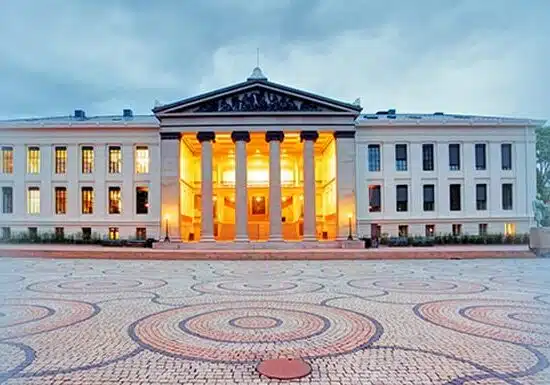
University of Oslo
- Students: 26,500
- Faculty and staff: 7,200
Its various academic and social societies make the University of Oslo a unique study abroad option. Students can choose from more than 200 active societies, organizations, and clubs, like political societies, special interest groups, publications, and theater groups, to name a few.
University of Bergen
- Students: 20,000
- Faculty and staff: 4,000+
Students at the University of Bergen can take full advantage of the nature surrounding the campus. Endless outdoor activities are available, like hiking in western Norway, mountain climbing in Gullfjellet, mountain sightseeing, and an exciting range of winter sports.
Norwegian University of Science and Technology (NTNU)
- Students: 43,500
- Faculty and staff: 8,430
Known for its top-quality research initiatives, NTNU has marked itself as a leading innovative and internationally-recognized university. Some of its main areas of research opportunities include energy, health, sustainability, and technology.
Norwegian University of Life Sciences (NMBU)
- Students: 7,000
- Faculty and staff: 2,000
Offering bachelor’s, master’s, veterinary medicine, and PhD programs, the Norwegian University of Life Sciences is an excellent option for incoming exchange students. Their interdisciplinary research contributes to the food, health, environmental protection, and sustainability sectors around the world.
Germany
Most public universities in Germany offer tuition-free undergraduate study, and students typically pay a semester contribution that often sits in the few-hundred-euro range.
There is one well-known exception: the federal state of Baden-Württemberg charges many non-EU/EEA students €1,500 per semester at public universities.
Remember to budget for living costs and visa-related expenses, and always verify the fees for your specific university and degree.
If you are searching for an English-speaking program in Germany, you may be interested in one of these universities:
Universität Freiburg
- Faculties: 11
- Campuses: 3
If you are already working in a full-time job, consider the Freiburg Academy of Continuing Education. Their programs include certificate courses designed to lay further theoretical grounding to your practical work experience. They also offer distance learning options for master’s degrees.
Georg-August-Universität Göttingen
- Faculties: 13
- Campuses: 1
Georg-August-Universität Göttingen is especially recognized for its diverse range of subjects and research-led teaching initiatives. It is no surprise that the university has graduated over 45 Nobel laureates!
Universitat Leipzig
- Faculties: 14
- Campuses: 1
Founded in 1409, Universitat Leipzig is one of the oldest universities in Germany, home to 14 different faculties and 460 top-quality professors. It has a long history of scientific developments and public services of general interest, including law, medicine, teaching, and pharmaceuticals.
France
France is not usually “tuition-free” in the same way as some German public universities, but public university fees can still be very low, especially for EU/EEA students.
For the 2025–2026 academic year, official public higher education registration fees are listed as €178 per year (Bachelor’s), €254 per year (Master’s), €628 per year (engineering schools, with some exceptions), and €397 per year (Doctorate).
France has also applied “differentiated” tuition for non-EU students in some cases, and it’s common to see exemptions or reduced amounts depending on the institution and program, so it’s important to check the exact fee rules for your situation.
Some universities you might explore in France include:
Jean Monnet University
- Students: 20,000+
- Established: 1970
- Bachelor’s, Master’s, and Doctorate degrees
Students at Jean Monnet University (UJM) can select from degrees ranging several different faculties, including: law, economics, management, arts, languages, science, technology, health, and social sciences. It is a great option for those looking to explore France’s Rhône-Alpes region!
Claude Bernard University
- Students: 47,000
- Established: 1809
- Bachelor’s, Master’s, and Doctorate degrees
Also known as Lyon 1, the university produces over 9,000 graduates per year and awards 350 PhD degrees per year. Students in the science and technology sector can select from 17 areas of expertise, 57 vocational BA degrees, and 111 MA degrees.
Paris Descartes University
- Students: 33,500
- Established: 1971
- All degrees, specializing in law, mathematics, medicine, social science, and sports
With nine different training and teaching faculties, Paris Descartes University stands out as a leader in the fields of human and health sciences. Not only do students have access to competitive career-oriented courses, but those pursuing higher education can select from 13 different doctoral schools.

In countries like Finland, Denmark, Norway, Germany, and Sweden, students who are not from the EU/EEA might be asked to pay a small yearly or semester fee, even if the school’s program is actually tuition-free. This is why it is important to do all your research beforehand. Make sure to speak with an academic advisor as soon as possible about your current financial state and the best plan of action for your upcoming academic needs.
Alternatively, if you are a student of the EU or EEA looking for academic opportunities in other member states, consider these top BA degree programs across Europe:
BA in Economics and Business Administration
- Germany – Berlin School of Business & Innovation
- Full-time
- Three-year degree
Bachelor’s Degree in Scientific Visualization
- Switzerland – Zurich University of the Arts
- Full-time
- 6-semester degree
BA (Hons) Fashion Design
- United Kingdom – London College of Contemporary Arts
- Full-time
- 3-year degree
Bachelor of Arts in Software Engineering
- Germany – Code University of Applied Sciences Berlin
- Full-time
- 3-year degree
BA in Film Directing and Video Games
- Poland – Warsaw Film School
- Full-time
- 3-year degree

For those who have already completed an undergraduate degree and are looking for graduate degree programs in Europe, you might be interested in these MA programs:
Master’s in Public History
- Poland – University of Wroclaw
- Full-time
- 4-semester degree
MSc.F in International Finance
- Switzerland – Geneva Business School
- Full-time
- One-year degree
Master of Business Administration in International Hospitality
- Netherlands – Hotelschool The Hague
- Full-time
- 13 months degree
Master in Business Analytics and Big Data – MiBA
- Russia – Saint Petersburg University
- Full-time
- 2-year degree
Master in Management
- Spain – Toulouse Business School – Barcelona
- Full-time
- 2-year degree
Why is Education More Affordable in Europe?
Many European countries fund public higher education through tax-supported models. In simple terms, taxpayers subsidize education more heavily, which can reduce tuition costs for students.
That doesn’t mean everything is free. You still need to budget carefully for living expenses, required fees, health insurance, and visa costs if you are moving internationally.
Online Degree Option: The Benefits of Distance Learning
If relocating is not realistic right now, online education can give you access to a degree without moving countries. Distance learning removes geographic barriers and can make it easier to study around work and family responsibilities.
For example, University of the People is a tuition-free, accredited, fully online university. Instead of tuition, you pay a one-time application fee and course assessment fees (undergraduate assessments are listed at $160 per course). UoPeople is accredited by WSCUC.
The Bottom Line
Whether you choose a public university in Europe with low or no tuition, or you decide to study online instead, it is possible to earn a degree without taking on the same level of student debt you might face elsewhere.
Your best next step is to shortlist a few countries, confirm whether the tuition policy applies to you, and then compare programs based on language, total costs, and the lifestyle you want while you study.
FAQs
Are universities in Europe really free?
Some are tuition-free for certain students (often at public universities), but you’ll usually still pay semester or administrative fees, and living costs can be high.
Can non-EU students study in Europe for free?
Sometimes, but it depends on the country. For example, Norway generally requires tuition for most non-EU/EEA students at public universities as of 2023, while many German public universities remain tuition-free, with notable regional exceptions.
Is university free in Germany for international students?
In most cases at public universities, tuition is not charged, but students typically pay a semester contribution. In Baden-Württemberg, non-EU citizens are charged €1,500 per semester at public universities.
Is university free in France?
France generally has low public university tuition fees, but non-EU students may be subject to differentiated fees at bachelor’s and master’s level unless an exemption applies.
What costs should I plan for even if tuition is free?
Plan for housing, food, transport, health insurance, visa costs (if applicable), and any semester or administrative fees.