
Advancing Innovation Through Inclusion: The Strategic Role of Women in Shaping the Future of Computer Science

Published: March 2, 2026
Computer science has never advanced through a single lens. From the earliest conceptual work in algorithms to contemporary breakthroughs in artificial intelligence, women have been central to defining how computing evolves.
Ada Lovelace articulated the first algorithm intended for implementation on a machine and, more importantly, recognized that computation could extend beyond arithmetic to symbolic manipulation. A century later, Grace Hopper championed the idea that computers should be programmed with words instead of symbols, directly influencing modern software development practices. During World War II and its aftermath, women programmers were responsible for operating, debugging, and extending early machines such as ENIAC, performing work that was later reclassified as engineering.

As computing matured, women continued to shape its theoretical and practical core. Margaret Hamilton led the development of onboard flight software for NASA’s Apollo missions and helped to formalize software engineering as a discipline. Her emphasis on fault tolerance and system reliability remains directly relevant to modern safety-critical systems and AI deployment. In parallel, Barbara Liskov made foundational contributions to data abstraction and object-oriented design, concepts that underpin contemporary software architecture and large-scale AI systems.
In artificial intelligence, women have played defining roles in both technical advancement and critical oversight. Fei-Fei Li, widely recognized as a pioneer in modern artificial intelligence, advanced computer vision through large-scale datasets while also advocating for human-centered AI. Her colleague Timnit Gebru brought global attention to bias, accountability, and environmental cost in AI systems, reshaping how responsible AI research is discussed and governed. Taken together, the work of women in computing demonstrates a consistent pattern: when women shape the field, computing becomes more rigorous, more reliable, and better aligned with real-world complexity.
Scientific Excellence Requires Intellectual Range
Strong research is not only about mathematical skill or coding ability. It begins earlier, with how a problem is defined. Who decides what questions are worth asking? What data is considered representative? What outcomes are treated as success? In computing and AI, these early choices shape everything that follows.
Those decisions do not emerge in a vacuum. They reflect the perspectives, experiences, and assumptions of the people making them. When leadership teams share similar backgrounds, they naturally approach problems in similar ways and may leave important gaps unexamined. Diverse leadership changes this dynamic by widening the range of perspectives involved in the research process.
Teams that include women consistently produce higher-quality research, not simply because they represent different users, but because they expand how problems are approached and debated. Women are more likely to question default assumptions, surface disagreements earlier, and press for clarity when trade-offs are glossed over. These habits improve decision-making, particularly in complex systems where small design choices can have large downstream effects.
This difference becomes visible in applied AI. Early voice recognition systems struggled with women’s voices because training data reflected narrow assumptions about speech patterns. Medical AI tools have misjudged symptoms because datasets and evaluation criteria were built around male-centric clinical norms. These were not failures of technical execution; rather, they were failures of judgment made upstream, before a single model was trained. When leadership includes people with different lived experiences and problem-solving styles, such gaps are more likely to be challenged early, when correction is still possible.
In this sense, women’s contributions to computing are not limited to inclusion in datasets or user groups. They shape how conflict is handled in teams, how uncertainty is evaluated, and how responsibility is assigned when systems affect real lives. These qualities strengthen research integrity and lead to technologies that are more resilient, more trustworthy, and ultimately more effective.
The Academic Imperative to Cultivate Inclusive Computing Ecosystems
Universities do more than prepare students for technical careers. They exercise influence over how disciplines define rigor, whose work is recognized as legitimate, and which lines of inquiry are pursued. In computer science, this influence carries particular weight because academic choices shape not only what is taught, but what is built. These decisions then become embedded in the resulting technologies. Treating gender diversity as peripheral to this work misunderstands the university’s role in shaping the field itself.
The responsibility of academic institutions is therefore structural, not symbolic. Inclusion must extend beyond admissions and enrollment figures to faculty leadership, curriculum design, research priorities, and institutional culture. When women are absent from these decision-making spaces, the discipline reproduces narrow definitions of excellence and limits its own intellectual range. When women are present and empowered to lead, academic environments become more rigorous, more self-critical, and better aligned with the realities their research seeks to model and influence.
This responsibility carries forward into the broader technology ecosystem. Universities train the researchers, engineers, and policymakers who will determine how artificial intelligence is built and governed. An academic culture that normalizes inclusive leadership produces graduates who expect diversity in collaboration, question inherited assumptions, and recognize ethical responsibility as part of technical competence. In this sense, cultivating inclusive computer science ecosystems is not only a matter of institutional identity but also a matter of academic integrity.
For institutions committed to scientific excellence and technological leadership, the conclusion is clear. Gender diversity is not an external demand placed on the academy. Instead, it is an internal requirement of the academy’s mission to advance knowledge responsibly and effectively. Universities that understand this will not merely respond to change; they will shape it.
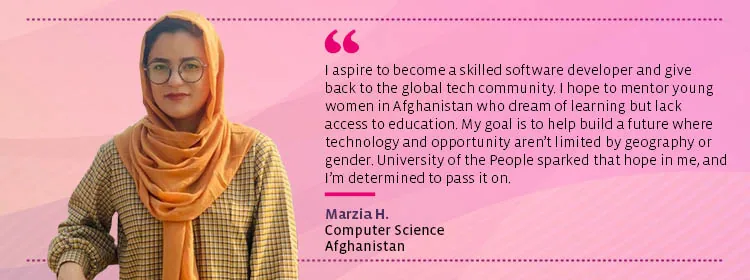
At University of the People, women are not just studying Computer Science — they’re thriving and reshaping what’s possible in tech. Students like Kimberly O., Marzia H., Sara A., and Emaan S. are pursuing their degrees in Computer Science with resilience and purpose, overcoming financial, geographic, and social barriers along the way. Many female learners choose UoPeople because of its tuition-free, fully online, flexible model that allows them to balance work, family, and study while developing in-demand technical skills. Their experiences underscore how accessible, flexible education can open doors for women in a field where diverse perspectives are essential to innovation and growth.